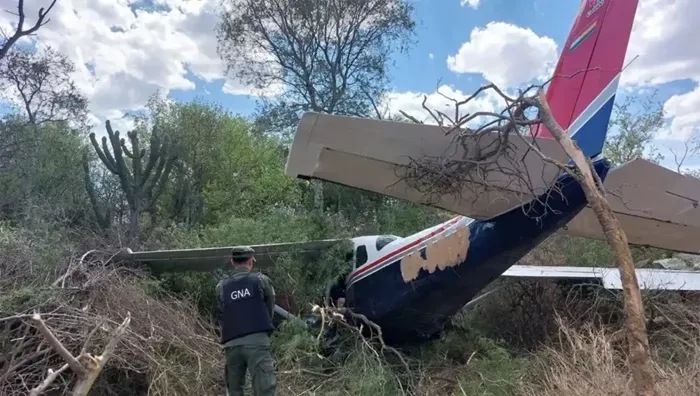
Buenos Aires, November 5, 2025 – Total News Agency-TNA – The crash of a Bolivian-registered light aircraft carrying 140 kilos of cocaine in the department of Rosario de la Frontera, Salta province, once again raises the question of air control on Argentina's borders. The government states that air control is improving, but security forces admit that 'planes fly very low' and 'below radar,' which complicates their preventive interception. The long-range radar system deployed on the northern border, which includes the RPA-240T model developed by INVAP and installed by the Argentine Air Force (FAA) in Tostado, Santa Fe, was precisely designed to monitor irregular flights in Argentine airspace. During a press conference by presidential spokesman Manuel Adorni, it was admitted that 'many more helicopters' are needed for the National Gendarmerie (GNA) to reach the landing zone in a timely manner. Two people were detained, and the aircraft was found burned along with a support vehicle that had been set on fire. Raids by the National Gendarmerie (GNA), Airport Security Police (PSA), and local police are ongoing. The incident highlights that, despite official announcements about radarization and air patrols, dozens of light aircraft cross the skies of northern Argentina daily without being intercepted until they crash or require ground detection due to neighbor complaints. The detainees are in custody, but Federal Prosecutor Eduardo Villalba is withholding details while the investigation progresses. Specialized agencies estimate that the use of small light aircraft and low-altitude flights reduces radar exposure time and complicates detection. Until this change is implemented, every crash or seizure will be reactive, and the cargoes that manage to touch Argentine soil undetected will continue to take flight. However, current operations remain scarce or untimely. In the case of Rosario de la Frontera, the light aircraft had supplementary fuel tanks, showing a deliberate strategy for long-distance drug trafficking. In 2016, the legal framework allowed the FAA to 'intimidate, warn, and shoot down' drug aircraft. However, reports of ground operations indicate that surveillance does not always prevent landing or unloading in remote areas. The central question is blunt: why are pursuit aircraft not deployed in real-time or shootdowns authorized when unregistered foreign aircraft repeatedly appear? A regional study indicates that the aerial vulnerability model is based on 'very low flight schemes, without a flight plan, with irregular routes that are only detected when the aircraft is already in national territory or has landed.' Apparently, setting up lookout posts is not in the authorities' plans. What underlies this is a structural problem of Argentine airspace sovereignty.